Machine Bylaws
The present public research priority, examining authority, accountability, oversight and control as artificial-intelligence systems become increasingly autonomous and consequential.
View programmeWider body of work
Causal Architectonics contains a wider landscape of independently developed research inquiries examining how consequential outcomes emerge from underlying structures, relationships, classifications, incentives and systems of authority.
These bodies of work differ materially in maturity, publication status, validation and present priority. Their inclusion records their place within the wider research landscape. It does not imply simultaneous execution, external validation, institutional adoption or committed publication.
Foregrounded research
The present public research priority, examining authority, accountability, oversight and control as artificial-intelligence systems become increasingly autonomous and consequential.
View programmeA foundational inquiry into how mathematical and scientific frameworks are constructed, interpreted, evidenced and inherited.
View programmeA complete jurisprudential reference work concerning legal attribution and responsibility for consequential conduct produced by autonomous systems.
View publicationField of inquiry
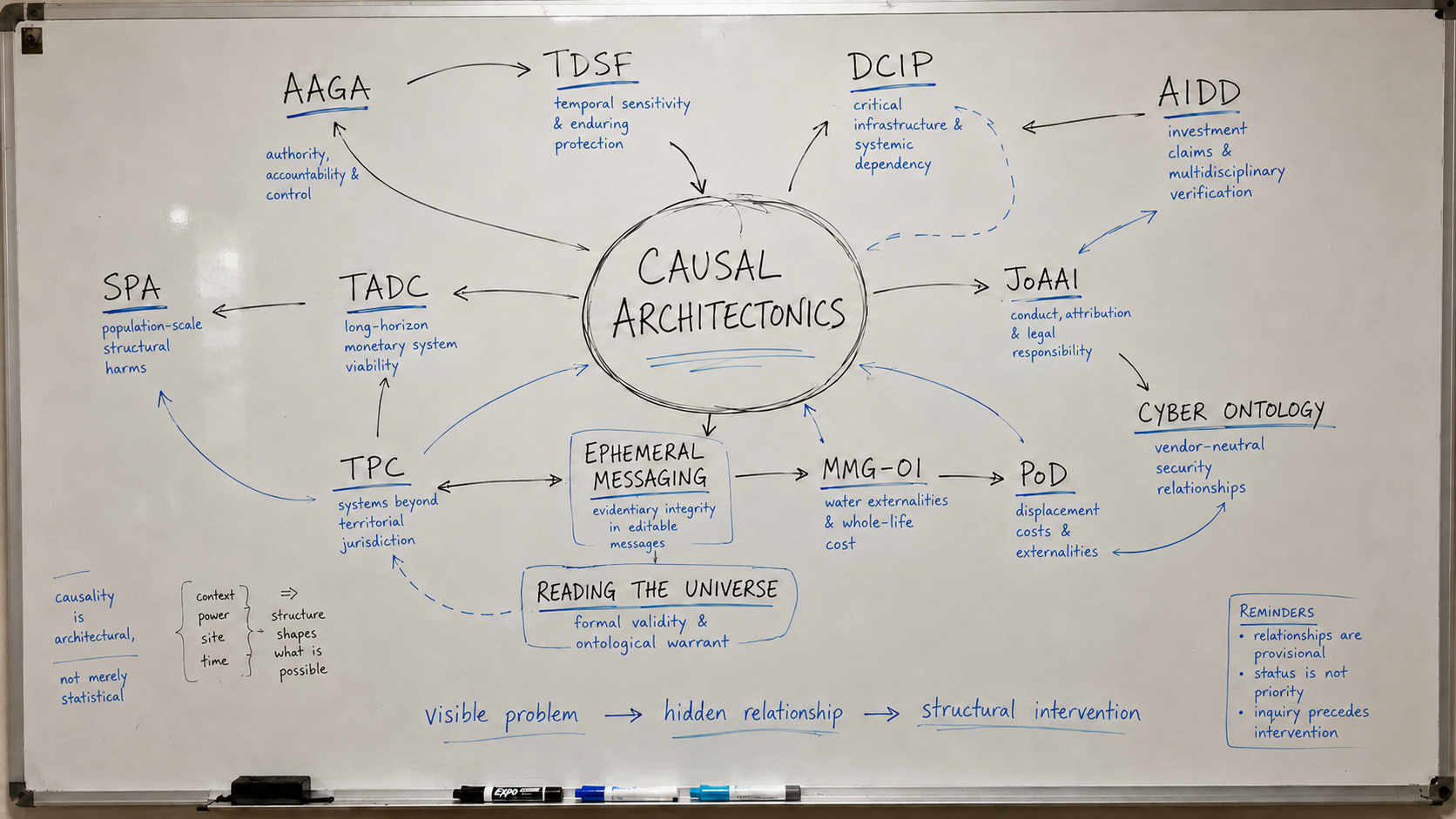
The whiteboard is an expressive view of the landscape as an evolving intellectual field. It is not a statement of project hierarchy, dependency or completion.
Controlled register
Twelve have completed a Programme Due Diligence Assessment. Reading the Universe remains an additional public programme outside that assessed baseline.
Examines how authority, accountability, oversight and control must be constituted when AI systems progress from advisory tools to consequential actors.
Develops a temporal classification layer for information whose required confidentiality may outlast the technologies, controls or assumptions protecting it.
Examines whether systemically important digital infrastructure providers require a horizontal governance framework comparable to other critical utilities.
Develops a multidisciplinary framework for testing the technical, operational, legal, commercial and governance claims underlying material investment in AI companies.
A complete jurisprudential work examining how existing legal doctrine can attribute conduct and allocate responsibility when autonomous systems select consequential means without becoming legal persons.
Examines the long-horizon viability of digital monetary systems whose continuity depends on growing ledgers, cryptographic assumptions, computation, incentives and liquidity.
Investigates how structural, population-scale harms arising from platform and AI-system design might be assessed and governed without collapsing the problem into content moderation.
Examines governance failures arising when critical digital, orbital, energy and supply-chain systems operate across or beyond the effective reach of individual territorial jurisdictions.
Develops a vendor-neutral ontology connecting system structure, adversarial behaviour, defensive control functions and the technologies used to implement them.
Examines how bilateral evidentiary integrity might be restored in ephemeral and editable messaging without requiring centralised content retention or surveillance.
Provides jurisdiction-neutral municipal evaluation guidance for making data-centre water demand, alternatives, infrastructure costs and environmental externalities visible in local decisions.
Develops a bounded framework for identifying and internalising economic costs transferred to workers, skill pipelines, regions and institutions when AI-driven capital substitutes for human labour.
Examines how mathematical and scientific frameworks are constructed, interpreted, evidenced and inherited, including the distinction between formal validity and ontological warrant.
Relationship architecture
The bodies of work are not versions of a single problem. Their relationships arise where recurring questions of authority, evidence, dependency, externality and ontological warrant cross disciplinary boundaries.
Authority, attribution and legal consequence
Accountable authority and displacement consequences
Persistence, mutation and evidentiary life
Classification supporting technical verification
Infrastructure dependency across jurisdictional boundaries
Digital infrastructure and transferred resource burdens
Long-lived systems beyond conventional territorial assumptions
Population-scale externalities
Structural harm and allocated external cost
Internalisation of costs outside the immediate transaction
Construction and warrant of categories and models
The corridors identify principal intellectual relationships. They do not mean that one body of work owns, contains or validates another.
Status and boundary
It does not measure intellectual importance, internal volume, funding priority or eventual scale.
The underlying assessments, work-package structures, unpublished implementation detail and internal completion judgments are not published through this page.